
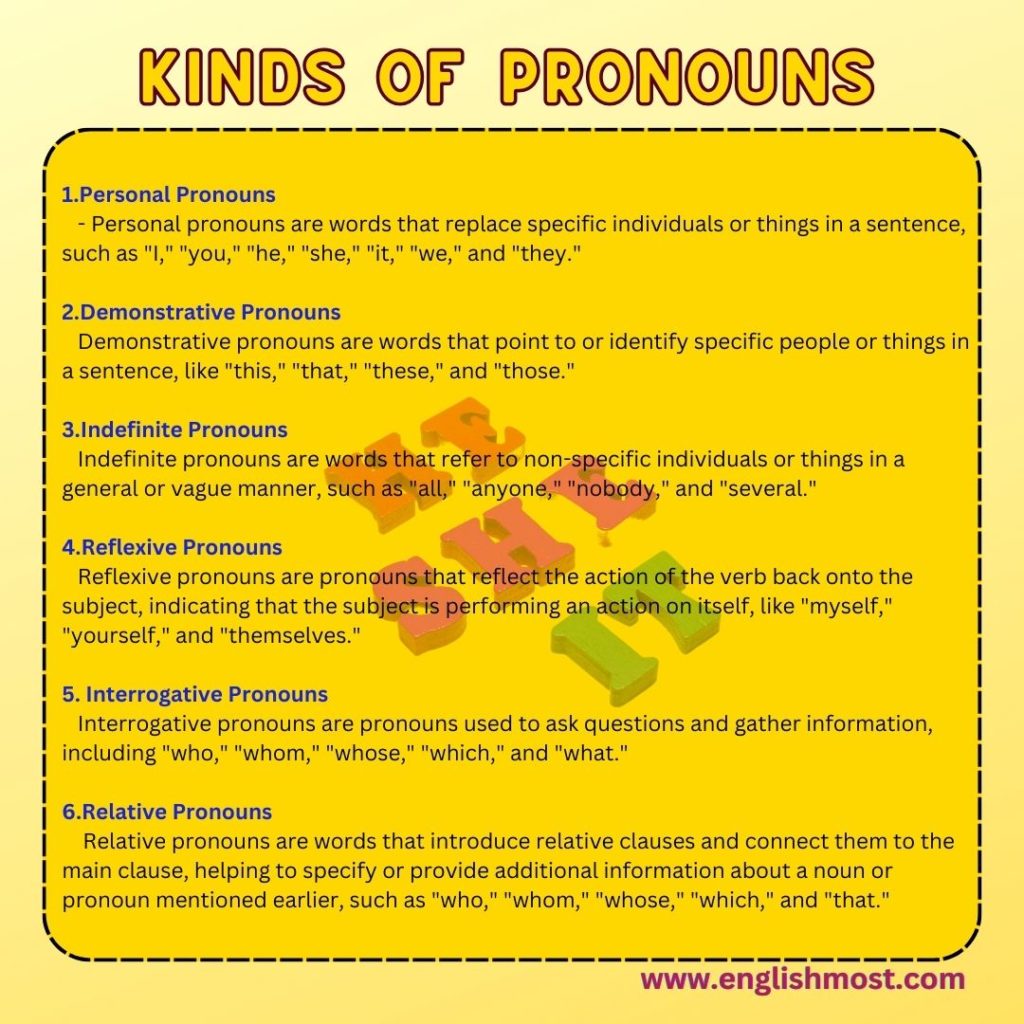
Pronouns are words that take the place of nouns in a sentence. Understanding the types of pronoun with examples helps improve grammar and sentence clarity. Below are the main types of pronouns along with examples. A pronoun makes the speech or written language sound more natural.Some examples of pronouns are, “I, we, you, they, he, she, it, you, they” and “who, whom, whoever, somebody”, etc. Let’s view the infographic on the kinds of pronoun.

Types of Pronoun with Examples
Here are 6 types of pronoun.
- Personal Pronouns
- Demonstrative Pronouns
- Indefinite Pronouns
- Reflexive Pronouns
- Interrogative Pronouns
- Relative Pronouns
Personal Pronouns
| Subjective Pronouns | Objective Pronouns | Possessive Pronouns |
|---|---|---|
| I | me | my, mine |
| you | you | your, yours |
| she | her | her, hers |
| he | him | his |
| they | them | their, theirs |
| we | us | our, ours |
| it | it | its |
Personal pronouns replace the names of persons or sometimes animals.They are used in subject or object positions.
- I told her an interesting story.
- She told me an interesting story.
In the first sentence “I”is in the place of the subject.since “I” is the one doing the action. When it is in the object positionit will change into “me”.
Likewise when “she” is in the subject position it is simply “she”. when it acts an an object it becomes “her” since she is the one receiving the action. The same way any female name will turn into “she” as subject and “her” as an object.
Possessive pronouns are pronouns which show possession of something.In the same way:
We can say for example:
- Michael owns a big house.The house across the street is Michaels’s house.
Instead of repeating Michael’s house, we can say:
- Michael owns a big house.The house across the street is his.
You will find online grammar quizzes to practice types of Pronoun with examples.Would you like doing this multiple Personal Pronouns Quiz? Just click on the title to open the quiz.
Demonstrative Pronoun
The Demonstrative Pronouns are kinds of pronoun used to point to a specific object. Some examples are
this, that, these, those.
Look at these examples:
- This is my sister’s purse.
- That looks like the bicycle I used to ride.
- These are not well knows books.
- Those apples are bigger than the one’s we bought last time.
Here is a Demonstrative Pronouns quiz with answers. Demonstrative Pronouns are words such as “this, that, these, those”.They are words that indicate or point to specific people, places, things, or ideas in a sentence.
Indefinite Pronouns
Indefinite Pronouns are types of pronoun that do not indicate an exact person or object such as someone, no body, anybody.Some more examples of indefinite pronouns are either, neither, any, some, several, many etc.
- Nobody wants to travel in icy weather.
- Some of my friends live in rural areas.
- Can anyone tell me the answer to this question?
Here is an Indefinite Pronouns quiz with answers. Indefinite Pronouns are words such as everyone, someone, anybody, many, each, none etc.
Reflexive Pronoun
Reflexive Pronouns are the kinds of pronouns that reflect back to the subject.
| Subjective Pronouns | Reflexive Pronouns |
|---|---|
| I | myself |
| we | ourselves |
| you | yourself, yourselves |
| they | themselves |
| he/she | himself/herself |
| it | itself |
- I fixed my lawn all by myself.
- Sara created an amazing art project all by herself.
- The Smiths went to the US five years ago. They established themselves very well within a short time.
Here is a reflexive Pronouns quiz with answers. Reflexive pronouns point back to the subject such as he/ himself, she/herself. Click on the link above to find the quiz.
Interrogative Pronouns
Interrogative pronouns are used to ask questions. The interrogative pronouns are what, which, who , whose, whom:
- What would you like for lunch?
- Which colour would you like for your car?
- Who is that weird guy?
- Whom are you going with to the party?
These pronouns are used to inquire about people, things, places, times, and reasons. Common kinds of interroative pronouns with include “who,” “what,” “which,” “whom,” and “whose.”
Relative Pronouns
Relative Pronouns are used to introduce relative, subordinate clauses. They work like conjunctions in joining two sentences.Examples are who, whom, whose, that, which, whoever, whomever etc.
Look at these examples:
- The guy who is waving is my friend.
- This is the house which was built in 18th century.
- The book, that I was reading, captured my interest every passing minute.
- In the group of four students, whoever is selected, will lead the group.
A relative pronoun is a type of pronoun that introduces a relative clause, which provides additional information about a noun or pronoun in the sentence.Common relative pronouns include “who,” “whom,” “whose,” “which,” and “that.”
Get more practice of English Grammar by following Interactive Grammar Quizzes.